One of the reasons we moved to Trinidad had to do with transportation. As awful as it is to comtemplate, there will probably come a time when neither of us will be able to drive. While we still drive, Trinidad is located directly on Interstate 25 and two other interstate highways are accessable. There is a local transporation system that runs a bus on a regular circuit and also has smaller vehicles for specialized transportation. This service goes to Raton and Walsenberg and twice a week goes to Pueblo for medical appointments.
The other long distance transportation is the AmTrak line that stops in Trinidad. The train is the "Southwest Chief" and runs daily between Chicago and Los Angeles. We have relatives at both end of the line. It is possible to transfer to the "River Runner" in Kansas City and go to St. Louis. We decided to take the "Southwest Chief" to Chicago to visit are new grandson (and family, of course). The bus in Trinidad picked us up at our house and dropped us off at the train station.
The eastbound train arrives in Trinidad at 4:46 p.m. and arrives in Chicago at 3:15 p.m. the next day. The only problem is that freight trains take priority over AmTrak and this can play havoc with the schedule. The train was 45 minutes late getting into Trinidad. Despite further delays, the train was only 1 hour late getting into Chicago. As an aside, it would be easy to get upset over these delays but if you think about it, it is no worse than being delayed by a traffic accident, slow service in a restaurant, or oversleeping at a motel. It is a delay of about 4%. The cost was about half of what it would cost and took only one-third of the time to drive. The cost was about the same as flying but without the discomfort.
So we boarded the train, were shown to our reserved seats and set off across the high plains of eastern Colorado and Kansas. The views were good - ranches and cattle, pronghorns and a coyote, Fisher's Peak as we left Trinidad, and a rising full moon over the prairie. It was more enjoyable than either driving or flying.
We went to the dining car for dinner. DMM had roasted chicken with rice pilaf and green beans and I had pork loin with mustard sauce, creamed spinach, and wheat bulgar. The food was excellent and the cost was no more than it would have been in a typical restaurant. The service was very good. For breakfast the next morning we went the beverage and snack bar in the observation car and ate while we watched the Missouri and Iowa landscape. Lunch was again in the dining car - hamburgers, chips and iced tea.
On the evening of the first night, the attendant came to the car, distributed pillows, and adjusted the lights. The seats are wider than airline seats and there is probably three times as much leg room. The seats reclined and were as comfortable as a reclining chair at home. What was missing was the television and a glass of Tulamore Dew. We slept the night in the coach car. Any complaints about sleeping are due to our age and physical conditions rather than the accommodations.
Returning home we called the bus from LaJunta and it met us at the station and took us home.
All in all, the train ride was enjoyable. It was much nicer than flying or driving. Both DMM and I would do it again. We would like to try a sleeping car, if we can afford it. It is really a shame that train travel isn't more widely used and available in this country. I guess it says something about the power of the airlines and highway departments.
Monday, September 10, 2012

Thursday, August 23, 2012
Weather
Several people mentioned how much snow we were going to get when we moved to Colorado, so I thought I might say something about the weather. Earlier in the spring, we had snow, rain, and sunshine all in one day. We came out for two weeks in November to look at houses. One day we woke to a couple of inches of snow and it was melted by noon. Later that week there were about 5 or 6 inches of snow and it was melted by the next day.
We bought a house and came out in late December for the inspection. We drove through snow from Colby, Kansas to Denver. The inspection was to be on a Friday but we received a call from the inspector postponing it until Monday as it had snowed 11 inches in Trinidad and the roof was covered. When we arrived in Trinidad on Monday (about 9 am) most of the snow had melted and the roads were clear. This seemed to be the pattern - snow and it quickly melts.
In April we awoke to a foot and a half of snow. I shoveled some of the walks and part of the driveway. In two days all of the snow had melted.
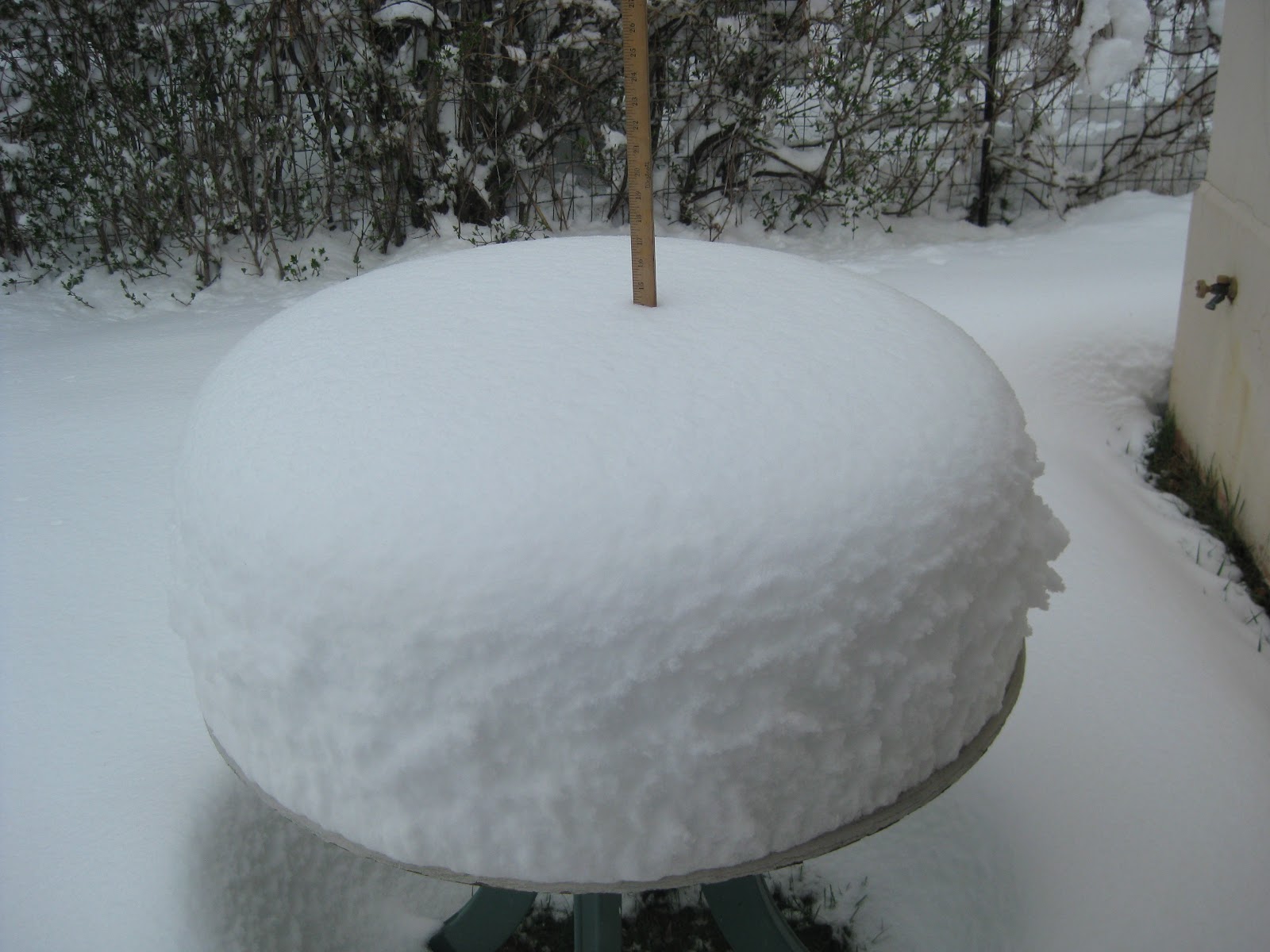

Spring and early summer were very pleasant. This summer has been hot and dry. Rain is much needed. The temperatures were high some days (over 100 degrees) but the low humidity made them bearable. The lack of rain has apparently caused the bears to come into town looking for food aand water. Some of the neighbors have seen them at night. We have not, although we did find where a bear relieved itself on our front lawn.
In general the weather is great, lots of sunshine, low humidity. Clouds over the mountains in the evenings making for beautiful sunsets. Usually we sit out on the lawn in the evening in a cool breeze with pretty skies.
Monday, August 13, 2012
Mini-Chaurauqua
We bought a season pass to Colorado's state parks. Trinidad Lake State Park (TLSP) has a series of presentations on Friday and Saturday evenings at their amphitheater and we have attended several of them. They have been entertaining and educational. The idea of Chautauqua presentations came to mind while driving to one the other night.
The presentations are hosted by Ranger Pat Patrick in the amphitheater on Caprios Ridge. Ranger Patrick is a wonderful host, funny, knowledgeable and who goes out of his way to make you feel welcome. From the ridge there is a wonderful view of Fisher's Peak (photo below) in one direction and the Spanish Peaks in the other

Located near the amphitheater are the campground and an old Jicarilla Apache camp. The only distracting aspect are the beautiful sunsets from the ridge. Sometimes it is not easy to pay attention to the presenters.
"Pretty, Prickly, and Persistent" was the first presentation we attended. It concerned the local ecosystem, the plants that grow in it, and how they have adapted to the environment. Having moved to a new ecosystem, it was interesting to discover some of the intricacies of it. After the presentation, the group took a walk around the area and observed many of the plants of the area.
Another presentation was on the native American and Spanish heritage of the southern Colorado area. We learned about the life and culture from the past of the area, the origin of place names, the foods they ate and how they were prepared. Within the amphitheater there is a horno, a beehive shaped adobe oven used by the native Americans and Spanish descendants. How the horno is used was explained and, as a bonus, Ranger Patrick baked "ranger biscuits" in it for us. It was amazing how delicious a simple biscuit baked in a horno and served with butter and honey is in the outdoor setting.

Not all of the presentations are about lectures and food. Two of the presentations were musical. One was a harmonica concert. A wide variety of music was played: popular, ragtime, blues, marches and rock and roll. In addition to the music, the history of the harmonica, the evolution of its use, and techniques were excellently explained to us. The second presentation was a pair of musicians playing guitars, mandolin, and a squibbler. Songs ranged from "Going Out to the Garden to Eat Worms" to Up on Cripple Creek", with additional songs that were new to me. Both presentations were thoroughly enjoyable evenings. The squibbler is an adaptation of a laptop dulcimer that look similar to and is played like a banjo.
All of this reminded me of Chautauqua -- I was educated, entertained, and buoyed up in spirit. I apologize for not getting the names of the presenters, they deserve to be mentioned.
Tuesday, August 7, 2012
The City of Trinidad
The City of Trinidad
Trinidad is a small town with a population of some10 000 people. It is located at an elevation of about 6000 feet in the Purgatoire River Valley about 200 miles south of Denver and some 20 miles north of New Mexico. It is located on the Santa Fe Trail and was a rest stop for the wagons before they crossed the Raton Pass into New Mexico. To the west are the Sangre de Cristo Mountains and to the east are the high plains where Clint Eastwood might have drifted. It is the county seat of Las Animas County, the largest in Colorado.
It is a picturesque town with old buildings, Victorian mansions, adobe houses, and brick paved streets. It is a friendly town; if you ask someone a question be prepared for a conversation. It is a town where people know each other and might be related to them. A wide variety of cultures are represented.
Trinidad has a Welcome Center for visitors. The people who staff the center have been most helpful in getting us oriented while and after we moved here. There are museums -- the Baca House, the A. R. Mitchell museum containing western paintings and artifacts, the Trinidad History museum, the Landon-Henritze Archeology Museum at Trinidad State Junior College and the Childrens' Museum at Old Firehouse #1. The Highway of Legends is a drive that takes you past Lake Trinidad, through several coal mining towns, past geological oddities, over Chucera Pass to La Veta and into Walsenberg.
Trinidad has a golf course, a skate park and aquatic center, movie theaters, restaurants, art galleries and shops. A river walk runs along the Purgatoire River and there are a number of fine parks. The Trinidad Triggers baseball team has their home field here. Surrounding are a number of small communities that have much to offer. I will try to expand on all of this as I write this blog.
Names are interesting. I have discovered that Trinidad refers to the Trinity. Las Animas is Spanish for the souls. The full name of the river is Rio de las Animas Perdidas en Purgatoire (Lost Souls in Purgatory River). The story is that Spanish explorers reached the river and were killed somehow. Since no priest was accompanying them, they could not be given last rites and would probably have to spend time in Purgatory. And the mountains that sometimes glow read at sunrise are called the Sangre de Cristo Mountains (Blood of Christ Mountains).
Monday, August 6, 2012
Recently my wife and I moved to Trinidad, Colorado from the Midwest. Trinidad is a small town in southeastern Colorado on the Purgatoire River at the foot of the Sangre' de Christo Mountains. The town has everything we were looking for in a place to retire. After living here for several months, I decided to write this blog to tell about Trinidad. I'm afraid that there will not be much order to the blog, hence the word "random" in the title.
Shortly after moving, in a newspaper article a local politician referred to us (not specifically us, but newcomers in general) as "transplanted newbies". The article reminded me of a story that my niece told me some time ago. She lives (born and raised, i.e., a native) in North Carolina. Apparently Northerners were moving into the state with different ways of doing things. A bumper sticker began to appear on cars in North Carolina. It read "We don't give a damn how you did things up North."
 Several Saturdays ago we attended a presentation by rangers at Trinidad Lake State Park on cooking in a horno. The horno is a beehive-shaped adobe oven used by both the Native Americans and those of Spanish descent throughout the southwest. I asked the presenter who originated the horno -- the Indians or the Spanish. He said that it originated in Africa, was brought to Spain by the Moors, and then to the Americas by the Spanish. This made me wonder if the Native Americans put bumper (or perhaps "rumper") stickers on their horses reading "We don't give a damn how you did things in Mexico". Carrying this thought a little father, maybe the Mexican settlers had a bumper sticker when the traders came from Missouri on the Santa Fe trail and the mountain men put bumper stickers on when the ranchers and farmers settled in the area. Perhaps, if you invented a time travel machine, you could go back in time and make a fortune selling bumper stickers to the Germanic and Celtic tribes saying, "We don't give a damn how you did things in Rome."
But I thought that as a transplanted newbie, I could tell about the place where I have chosen to live out my life. Trinidad seems to be a wonderful place and daily I am finding out more that I like about it.
Shortly after moving, in a newspaper article a local politician referred to us (not specifically us, but newcomers in general) as "transplanted newbies". The article reminded me of a story that my niece told me some time ago. She lives (born and raised, i.e., a native) in North Carolina. Apparently Northerners were moving into the state with different ways of doing things. A bumper sticker began to appear on cars in North Carolina. It read "We don't give a damn how you did things up North."

But I thought that as a transplanted newbie, I could tell about the place where I have chosen to live out my life. Trinidad seems to be a wonderful place and daily I am finding out more that I like about it.
Subscribe to:
Posts (Atom)